Boulder’s Arts and Community Spaces: Why Local Culture Needs a Record
Contemporary independent editorial essay. This is not a recovered article from the historic Boulder Magazine. Editorial note: Dates and institutional descriptions in this essay are attributed to linked sources. Readers should check current visitor information and original records before relying on operational details or interpreting historical materials as complete.
Culture is made in ordinary places
An arts scene is often described through its best-known institutions, but its real geography is more complicated. Work is rehearsed in borrowed rooms, shown in temporary exhibitions, discussed in cafes, and shared at events that may leave little documentation. Boulder’s creative life includes formal venues and informal networks, each contributing something different. A museum can preserve institutional memory through catalogs and program records; a neighborhood organizer may have only a poster, an email announcement, or a photograph. A useful cultural history makes room for both. It treats creativity as a set of relationships between people, spaces, audiences, and the changing city rather than as a simple list of celebrated names.
A museum with a changing identity
The Boulder Museum of Contemporary Art traces its origins to a group of local artists who founded the organization in 1972. Originally called the Boulder Arts Center, it moved in 1976 to a historic downtown building that had previously served as a warehouse; the institution adopted its current name in 1995. These dates offer a useful example of cultural continuity without implying that nothing changed. Names, buildings, audiences, and curatorial priorities can evolve while an organization remains part of the local arts conversation. The museum describes itself as a non-collecting institution, emphasizing exhibitions and programs rather than a permanent collection. That distinction matters when researchers look for records of past shows.
What a venue contributes
A gallery or performance space does more than present finished work. It creates opportunities for artists to encounter audiences, for students to see unfamiliar forms, and for residents to meet across professional or social circles. Programs can also connect local practice with regional and international conversations. Yet the significance of a venue cannot be measured solely by attendance. A small workshop may change the direction of an emerging artist’s practice; a short-lived exhibition may introduce a new public question. When writing history, it helps to examine the program itself: who organized it, where it took place, what was presented, and how participants described the experience. These details are more useful than unsupported claims that an event was transformative.
Buildings as cultural evidence
The physical setting of an arts organization shapes the experience of visiting it. A former warehouse, a converted storefront, or a shared studio carries traces of earlier uses. Changes to a building may reveal how a neighborhood’s economy and priorities shifted. But a photograph of a facade cannot explain everything. Researchers need dates, maps, planning records, and firsthand accounts to understand how a space functioned. Boulder’s historic buildings are especially useful subjects because cultural and commercial uses often overlap. A responsible archive labels what is known about a location and avoids assigning an invented history to an attractive old photograph.
The value of temporary work
Many artistic experiences are deliberately temporary. Performances end, murals change, and installations are dismantled. Their disappearance is not a failure; it is part of how the work was intended to be encountered. The archival challenge is to document enough context to make the event intelligible later without pretending a photograph reproduces the original experience. A program, artist statement, review, or recorded conversation can help. Permission and attribution matter as well, particularly when images or recordings are involved. An independent editorial site should describe historic work and link to legitimate collections rather than copying protected materials simply because they are easy to find online.
Who is visible in the record
Cultural histories tend to privilege organizations that kept formal records. That can leave community festivals, youth programs, experimental spaces, and artists working outside established institutions less visible. The imbalance is partly practical: institutions may have archivists, while volunteer projects often change hands without a filing system. It is also editorial. A publication may repeatedly cover familiar venues and overlook events outside its usual audience. Recognizing those limits improves the record. Instead of claiming to speak for every artist in Boulder, an archive can identify its sources, seek additional perspectives, and explain where evidence is incomplete.
Libraries as partners in cultural memory
The Carnegie Library for Local History holds photographs, documents, newspapers, maps, and oral histories that can illuminate cultural life alongside other aspects of Boulder County’s past. These resources can help establish when a venue operated, how an event was described, or what a street looked like before redevelopment. Newspaper listings are particularly useful for reconstructing short-lived programs, although they usually tell us more about publicity than audience response. Oral histories add interpretation and memory, which should be read with attention to when the interview took place. The strongest accounts use multiple kinds of evidence rather than relying on a single attractive anecdote.
Art and the landscape
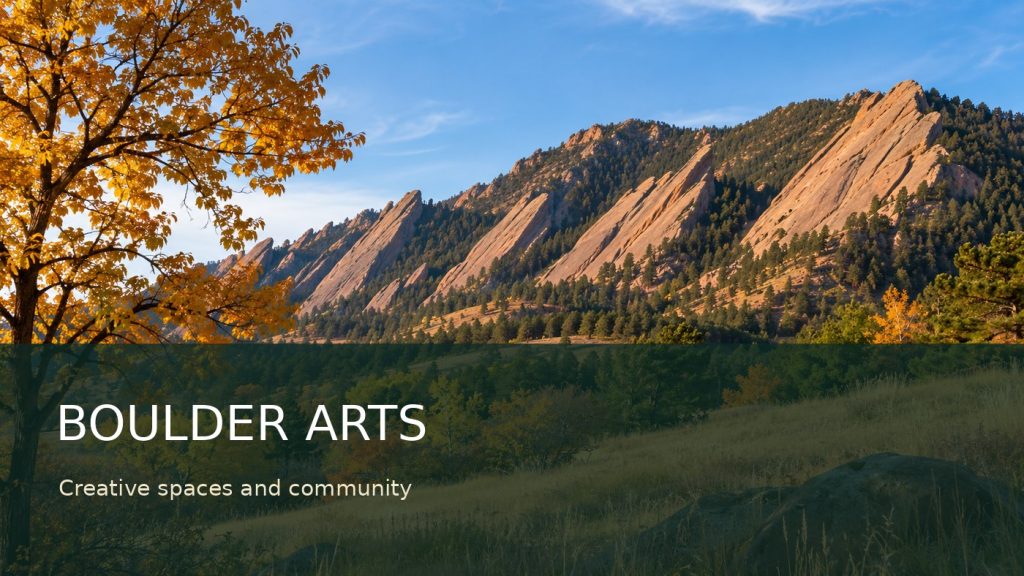
Boulder’s mountain setting provides an enduring subject for visual culture, but there is no single artistic response to it. Some artists emphasize the monumental shape of the Flatirons; others focus on human activity, ecological change, or the tension between development and conservation. Images of landscape can celebrate place while also raising questions about whose experience is represented. Our feature on the Flatirons and public space explores the physical and civic setting behind those images. Pairing cultural work with land-use history can make both subjects richer, provided the interpretation does not claim to speak for an artist without evidence.
Writing a durable cultural record
A practical record of an exhibition or event should begin with the basics: a confirmed title, date, location, organizer, and source. If photographs are included, captions should identify the subject and credit the creator when known. Contemporary commentary should be clearly dated, and corrections should be visible rather than quietly rewritten into the past. Independent local journalism often provides the first draft of this record, which is why our essay on Boulder’s changing press is a useful companion. The goal is not to freeze cultural life in a permanent display. It is to leave enough reliable evidence that future readers can ask better questions about what happened and why it mattered.
Preserving an event without inventing its legacy
It is tempting to describe every rediscovered exhibition as a turning point. That language makes a lively headline, but it can flatten the experience of people who were actually there. A more durable account begins with modest questions. Can the date and venue be verified? Is there a surviving program or announcement? Was the work reviewed by an independent publication, and does that review distinguish description from opinion? Are images available with clear rights and captions? If the evidence is limited, the story can still be worth telling. It may reveal how a space was used, how artists collaborated, or how an audience encountered unfamiliar ideas. The writer should simply resist claiming a lasting influence that has not been demonstrated. A record that admits uncertainty is more useful than one filled with confident but untraceable judgments. Over time, additional materials may emerge, and a transparent archive leaves room for them without erasing earlier gaps.
Sources and further reading
The relationship between creative spaces and everyday leisure also extends into interactive entertainment, as explored in our feature on the evolution of arcades and browser-based games.