Boulder’s Independent Press and the Changing Local News Landscape
Contemporary independent editorial essay. This is not a recovered article from the historic Boulder Magazine.
A city told through its publications
A local publication is more than a delivery system for announcements. It is a record of what a community considered important at a particular moment. A story about a neighborhood meeting can reveal a conflict over public space; an arts calendar can show which performers and venues formed the center of a cultural scene. In Boulder, where civic activism, the university, outdoor recreation, and a changing local economy meet, those small editorial decisions add up to an unusually varied record. Yet no single outlet captures the whole city. A magazine, a daily newspaper, a student publication, and a community broadcaster will often describe the same event from different vantage points. Reading across them is more revealing than treating any one as definitive.
The different jobs of local media
Newsrooms that report on budgets, elections, and schools perform a different task from publications that document restaurants, artists, or the rhythms of neighborhood life. The distinction is not a hierarchy. Investigative reporting helps residents hold institutions accountable, while cultural writing can preserve the ordinary details that disappear from official records. Radio adds voices and sound; photographs show streets and buildings before they change. A useful history of Boulder’s media therefore needs to ask what each format could see, whom it addressed, and what its business model made possible. It should also ask who was missing. An apparently comprehensive account may reflect the perspective of a narrow audience rather than the experience of the whole community.
How the archive changes the story
The Carnegie Library for Local History maintains documents, photographs, maps, oral histories, and historic newspapers that help readers test claims against dated evidence. Its newspaper holdings include microfilm, while the Maria Rogers Oral History Program preserves interviews that can complicate a purely institutional account. A newspaper article tells us what was reported at the time; a later oral history may reveal how the event was remembered. Neither automatically cancels the other. Researchers can compare the date of a story, its named sources, the physical location it describes, and any surviving public records. That process is slower than relying on a search result, but it produces a more trustworthy account.
From print circulation to online discovery
Print readers often encountered local journalism as a bundled product. The same issue might contain city reporting, theater listings, a letter to the editor, and advertising from businesses down the street. Online distribution separated those elements. A reader arriving from a search engine may see a single article without the surrounding issue, and a social-media share may circulate without the original publication date. This change expands access but strips away context. It also makes a publication more dependent on platforms whose ranking and distribution rules it does not control. For a historical archive, retaining issue dates, bylines when known, and source references is therefore not cosmetic. Those details help reconstruct the setting in which the story originally appeared.
A revealing discussion from 2009
A 2009 elephant journal discussion of regional online media named Boulder Magazine alongside other local outlets while debating the value of independent journalism. That article is a snapshot of one moment, not proof that every organization mentioned operated continuously or retained the same ownership. It does, however, illustrate an enduring question: can a large platform deliver local coverage with the same attention as publications embedded in the community? The answer depends on staffing, editorial priorities, relationships with sources, and the ability to correct errors. A familiar brand alone does not guarantee any of those qualities.
What a broken link can and cannot prove
Old web addresses are often treated as disposable once a publication redesigns its site. Yet a broken path can be the last visible trace of an article cited by another writer. Its existence may tell us the original publication organized stories by neighborhood or subject, even when the text itself is unavailable. It does not authorize anyone to invent a replacement article and label it a recovered original. The responsible approach is to check archived captures, identify the historical title and author when evidence exists, and separate a verified transcription from a modern explanation. If the source cannot be located, say so. Readers should never have to guess which parts of a page are original and which were written later.
Who gets preserved
Archives are shaped by editorial choices and by accidents of survival. Organizations with money and stable storage are more likely to leave extensive records; smaller neighborhood initiatives may leave only a flyer or a passing mention. Photographs of downtown can be plentiful while documentation of everyday work in outlying areas is sparse. A thoughtful local-history project should not mistake that imbalance for a measure of importance. It can describe what is present, note where the record is thin, and direct readers toward libraries, museums, and community collections that hold different kinds of evidence. Preservation is most useful when it makes omissions visible instead of quietly reproducing them.
A practical reading method
Begin with a question narrow enough to investigate: how was a park proposal debated, how did an arts venue develop, or what did a neighborhood newspaper cover during a particular year? Locate one dated source, then compare it with another source produced independently. Record the publisher, date, title, and any relevant page number or stable URL. Look for corrections or follow-up reporting. When a historical article uses language that feels unfamiliar today, explain its context rather than silently changing it. This method applies equally to a newspaper clipping and a web page. It makes the resulting narrative auditable and gives future readers a path back to the underlying material.
Connecting the local record
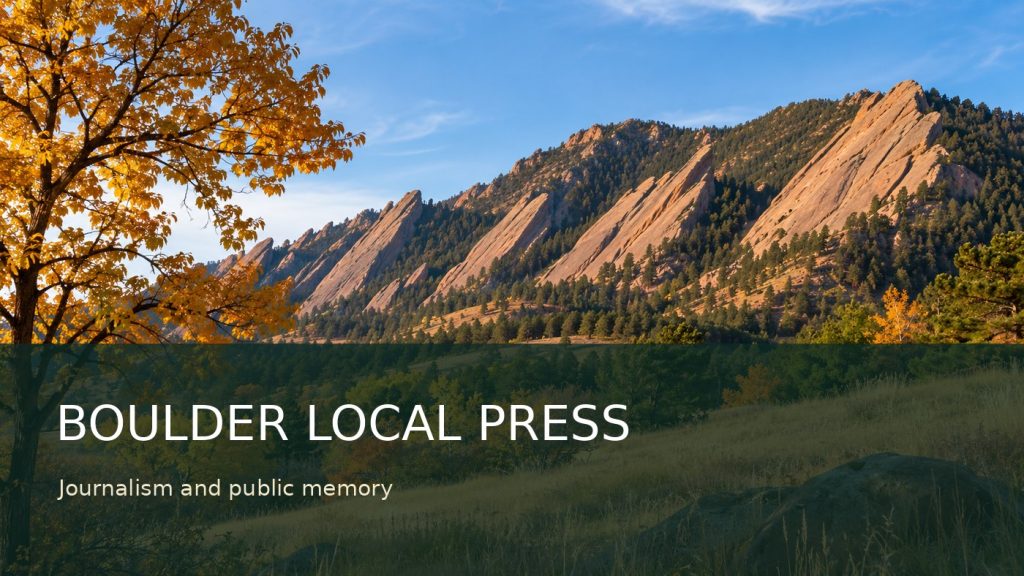
Local reporting becomes more meaningful when read alongside the physical and cultural places it describes. The story of conservation around the Flatirons, for example, intersects with debates about public access, recreation, and civic identity. Our companion feature on Boulder’s landscape and recreation follows that connection. The changing role of galleries and creative spaces is explored in Boulder’s arts and community spaces. These are contemporary essays, not reproductions of historic Boulder Magazine articles. Their purpose is to connect independently verifiable sources while keeping the boundary between recovered history and new interpretation clear.
Questions worth asking of every source
A careful reader can ask a few consistent questions of almost any piece of local reporting. Who published it, and what audience did the publisher expect? Is the date the date of the event, the first publication, or a later update? Are statements attributed to named participants, supported by documents, or presented as editorial judgment? Does the piece link to a meeting record, exhibition program, or public notice that can be examined independently? Equally important, what does it leave out? An article about a downtown development may quote officials and merchants while giving little space to tenants or workers. These gaps do not automatically make the reporting worthless, but they tell researchers where to look next. Comparing the article with another outlet, a library collection, and contemporary public records can turn a single story into a more balanced account. The goal is not to declare one publication perfectly objective. It is to make the evidence visible and the limits of interpretation clear.
Sources and further reading
Local cultural records increasingly include digital experiences, making the changing culture of digital entertainment another subject worth documenting.